
Most restaurants opening their doors for the first time face the same problem. They have a beautiful space, a well-crafted menu, and an owner who genuinely cares about the experience. What they do not have is a system to consistently put the right people in the right seats.
This is that story.
When this halal hotpot and BBQ grill restaurant first came to us, their digital presence was essentially nonexistent. On Instagram, they were posting sporadically with no real content direction. On Facebook, their page had a reach of just 3 people in the month before we stepped in. Three.
This was not a rescue operation. The restaurant had strong fundamentals. It’s a dual hotpot and BBQ concept, a private dining room that seated up to 15 guests, and a menu built around premium cuts and house-signature sauces. What they needed was a clear strategy to introduce the brand to the right audience and convert interest into actual table bookings.
The commercial objective was specific: group bookings, i.e. tables for six or more. A party of twelve in the private dining room is worth significantly more per shift than three tables of two. But according to 2025 restaurant industry data, 60% of consumers use Instagram to find new restaurants, and 57% of diners ultimately book through social media platforms. That opportunity only works if your profile and ads give them a reason to act.
The group booking is also harder to earn. It requires someone to discover the restaurant, share it with their group, build consensus, and commit. That is a longer decision chain than a couple deciding where to eat tonight. The social media strategy had to account for both moments.
We set four objectives for the twelve-month engagement:
We do not separate content strategy from paid ads. As we have written before, paid social and organic social are not competing, they are doing different jobs. For a brand-new restaurant with no existing audience, the two have to work together from day one.
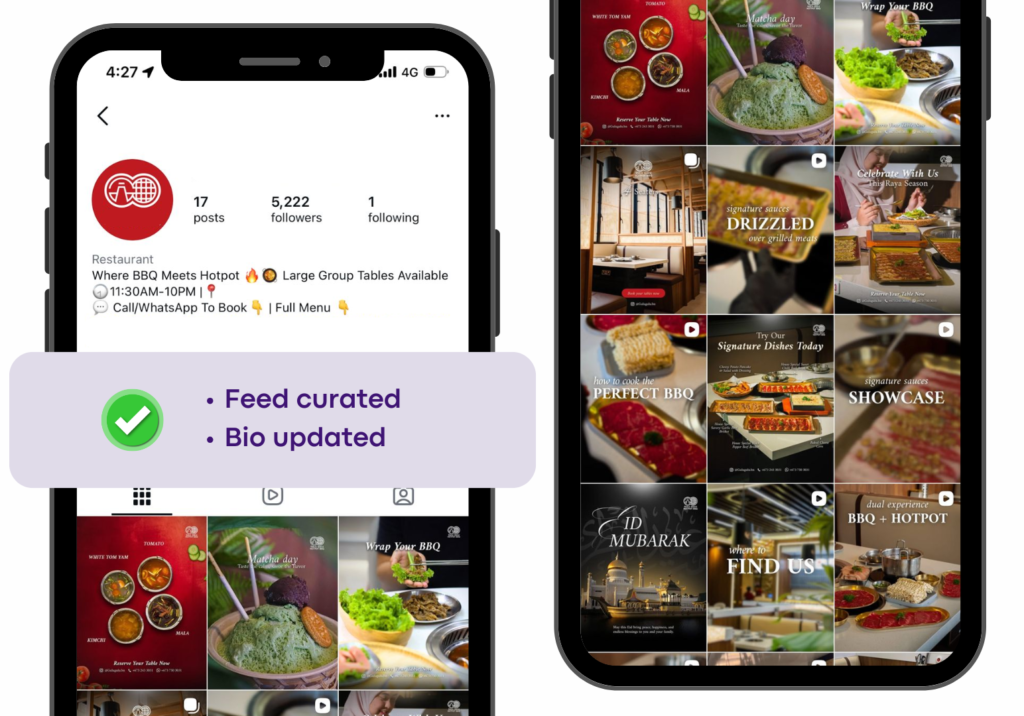
Before a single ad went live, we curated the Instagram feed and rewrote the bio. The previous profile gave visitors no clear reason to stay. We updated it to lead with the dual dining experience (BBQ meets Hotpot), flag the large group tables, and make it immediately easy to inquire via WhatsApp.
This matters more than it sounds. When an ad works and someone taps through to the profile, they make a judgment call in under five seconds. A disorganised feed with a vague bio sends them straight back out. A clean, curated profile that answers “what is this place and why should I care?” keeps them there. 40% of diners visit a restaurant after seeing food photos online, but only if the visual presence gives them something worth stopping for.
Many restaurants make the mistake of boosting posts and expecting the same results as a structured ad campaign. We did neither. We built a proper two-layer system where each layer doing a distinct job.
Engagement Campaigns (Top of Funnel) pushed multiple creatives to a cold audience at the lowest possible cost per result. The goal here was reach and brand recall, i.e. getting enough people to see the restaurant so that when the conversion campaign followed, they already felt familiar with it.
Messages Campaigns (Conversion) then retargeted warmed audiences with creatives specifically designed to start a booking conversation in Instagram DMs. This is where we tracked what actually matters: messages received, and how many of those became confirmed reservations.
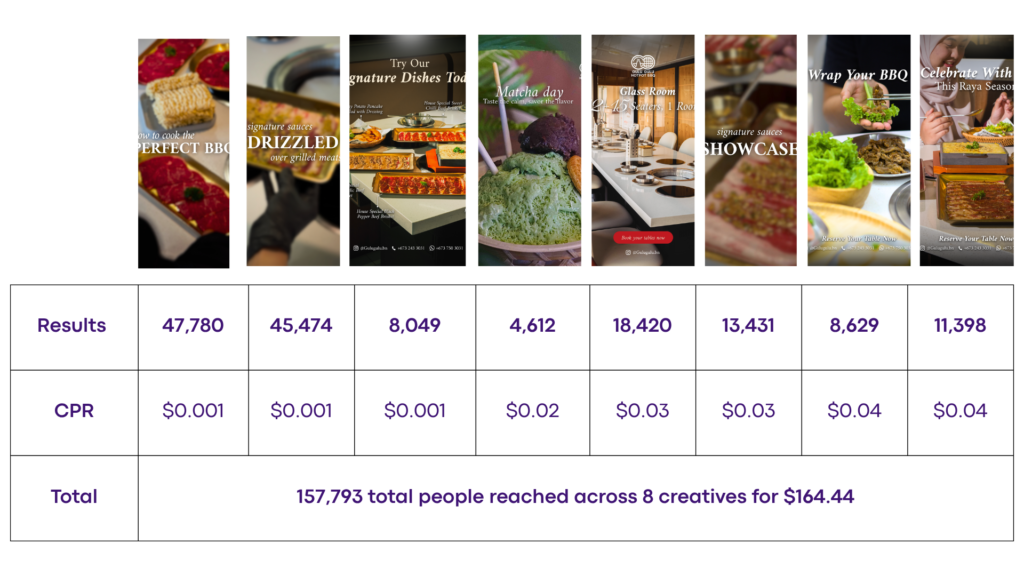
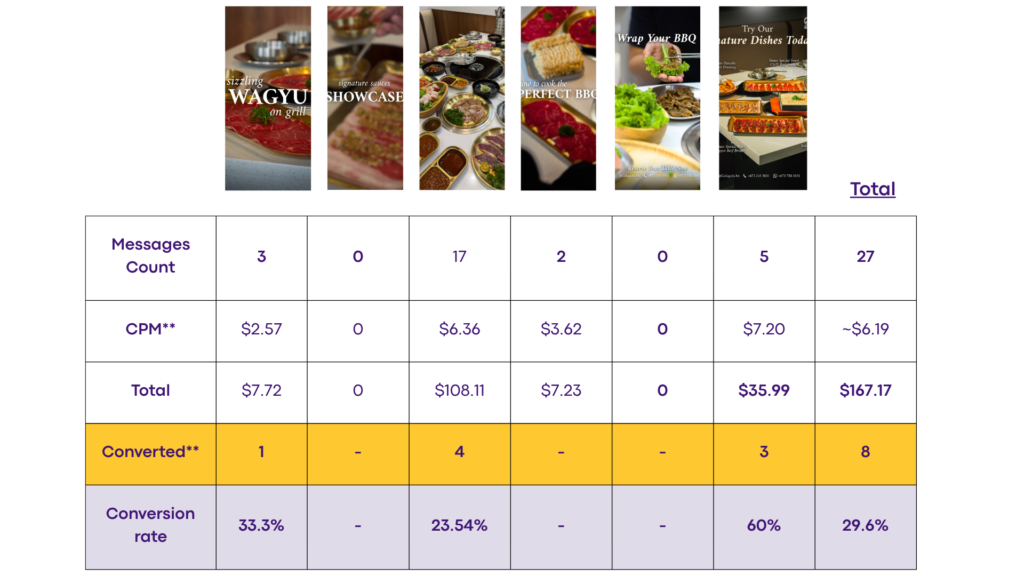
We did not guess what would work. We tested, and the data made the decisions for us.
As we explain in our piece on why your Meta ad creative is the strategy, the right creative finds the right person. The wrong creative burns budget against the same audience and gets nothing back.
In March, four creatives ran in the messages campaign. The “Opening Post”, a full spread of the restaurant’s dishes laid out on a group table, generated 7 messages and converted 6 of them into actual reservations. That is an 86% conversion rate on a single creative. We scaled it in April.
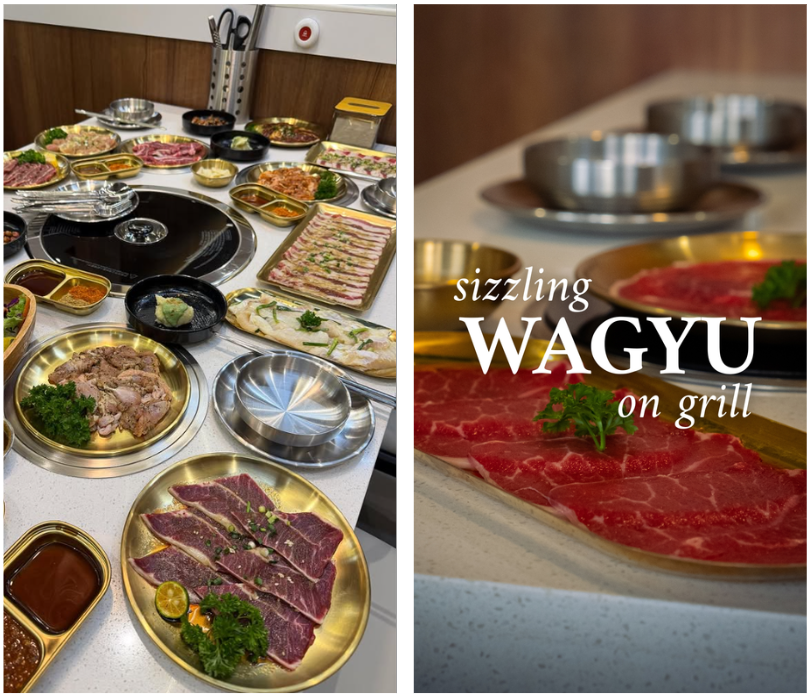
The “Sizzling Wagyu on Grill” video came in second at $3.78 CPL, it’s the most cost-efficient lead source across both months.
Here are the combined results across the two out of the twelve-month engagement:
IG: 6,600 → 48,900 (641% increase from Feb baseline)
FB: 3 → 66,000 cold launch in a single month
20 messages from paid campaigns.
11 bookings confirmed
11 bookings with only $208.11 ad spend
IG: 48,900 → 73,000 (Up 49.3% from March)
FB: 66,000 → 98,000 (Up 48.5% from March)
36 messages from paid campaigns and organic.
11 bookings confirmed
11 bookings with only $331.64 ad spend
By May, we have switched to using WhatsApp business app rather than Instagram DMs which lowered the CPL by 10x.
Two things became clear through this engagement that apply well beyond the restaurant industry.
The first: a new brand cannot skip the foundation work. If you are running ads before your profile is ready to convert a visitor, you are paying to drive traffic into a dead end. We curated the feed and cleaned up the bio before a single dollar of ad spend went live because when the ad works, the profile has to close the deal.
The second is subtler and more important for anyone trying to fill group tables, event seats, or any reservation that requires a group decision.
Research consistently shows that 50% of diners have tried a new restaurant after seeing it on social media but the metric that predicts which restaurant they choose depends entirely on the type of decision they are making. A couple deciding where to eat tonight will act on a great-looking plate. A family of ten planning a birthday dinner is asking a very different question: “Can this place actually hold all of us comfortably?”
Showing them the private dining room (the long table, the individual grill stations, the space to celebrate) answers that question. It gets saved. It gets shared. It becomes the post someone forwards to the family group chat that tips the decision.
Restaurants with active, strategic social media presence enjoy 5–10% higher annual sales, but the gap between “active” and “strategic” is exactly what we found in this engagement. The difference between a post that goes mildly viral and a post that fills a table is not reach. It is relevance to the actual decision the customer is making.
Before your next campaign, consider:
For this restaurant, the tables are filling up. And now we know exactly which content fills them.
Inspired by this case study? Explore more of our work across different industries here.
If you run a restaurant or F&B business and want a system that consistently drives group bookings — not just followers — we would love to talk.
📩 Email us at hello@synapsebn.com or book an open chat — no selling, no pressure.