
Most businesses treat the content calendar as a scheduling tool. Slots get filled, posts go out, and the week feels productive. The problem is that a calendar full of posts is not the same as a calendar built on strategy. One keeps you busy. The other builds an audience.
The businesses we work with that struggle most with organic social tend to share a common pattern: they post when they have something to say, go quiet when they do not, and then wonder why their engagement is flat and their follower count is stuck. Consistency, when it does happen, is accidental rather than designed.
A good social media content calendar solves a different problem than most people think it does. It is not a productivity tool. It is a commitment device that forces you to think about what you are saying, to whom, and in what format, before you are standing in front of a camera thirty minutes before a post was supposed to go live.
What follows is what that actually looks like in practice.
Why Most Content Calendars Fail Before the First Post Goes Out
The most common version of a content calendar is a spreadsheet with dates in one column and post ideas in another. Sometimes there is a column for the platform. Sometimes there is a column for the format. Almost always, it falls apart by week three.
It falls apart not because the team stopped caring, but because the calendar was built on availability rather than architecture. It answered “when will we post?” without first answering “what will we say, and why does it matter?”
A social media content calendar that works starts with the content mix, not the schedule. Deciding what types of content you need before deciding when to post them means that when you sit down to plan a month, you are not staring at blank cells and hoping for inspiration. You are filling a framework that already knows what it needs.
The other thing most calendars get wrong: they plan to the absolute limit of capacity. Every slot is filled, every week is packed, and the moment one piece of content takes longer than expected, the whole system collapses. A calendar without buffer space is a calendar that will be abandoned.
The Content Mix: What to Post and in What Ratio
Content mix is the strategic question underneath every calendar. Without it, you default to posting whatever is easiest or most convenient, which tends to mean promotional content, which tends to drive people away.
A useful framework is the 70/20/10 split: 70% of your content is planned and evergreen, 20% is reactive to what is happening in your industry or local context, and 10% is experimental. You are testing a new format, trying a different angle, or going off-script in a way that might not work. That 10% is where most organic growth actually comes from, but it only functions well when the other 70% is reliable enough to absorb the risk.
Within that planned 70%, a further split matters. Sprout Social’s content calendar guidance describes what most practitioners converge on: roughly one-third of posts build brand awareness and demonstrate expertise, one-third foster community through questions, conversations, and behind-the-scenes content, and one-third move people closer to a decision. The exact ratios shift depending on your business and where most of your audience sits in their relationship with you, but the principle holds. If more than half your posts are promotional, you are talking at your audience rather than with them.
The 60/40 split between evergreen and timely content is also worth building into the structure from the start. Evergreen content, posts that are relevant any day of the year, gives you a library to draw from when reactive content does not materialise. Timely content, tied to seasons, events, or current conversations, keeps the account feeling alive and relevant.
Posting Cadence: How Often Is Actually Enough
This is the question most businesses ask first, and it is actually one of the less important decisions you will make if the content quality is not there. A poor post published daily will underperform a strong post published three times a week every time.
That said, the research does point to useful ranges. For Instagram, Rival IQ’s 2025 Social Media Benchmark Report finds that the brands with the strongest organic performance post to the feed around 4-5 times per week, supported by regular Stories and 2-3 Reels. For Facebook, the effective range is lower: 1-2 posts per day is the ceiling before diminishing returns set in, and many brands perform just as well posting 4-5 times per week.
The counterintuitive finding in most frequency research is that engagement rate tends to peak at lower posting volumes. Accounts that post once or twice a week often see higher per-post engagement than accounts posting daily, because each piece of content gets more attention, more promotion budget, and more care. More posts means more content to produce, which often means lower quality per piece. The calendar should reflect what your team can genuinely sustain at a high standard, not the theoretical maximum output.
Start conservatively. Three posts per week on Instagram, including one Reel, is a cadence most small teams can maintain with quality. Build from there once the system is working, rather than committing to a volume you will struggle to hold for more than a month.
Format Variety: What to Post and When
Format is not just an aesthetic choice. Different formats do different jobs in the feed, and a calendar that uses only one or two formats is leaving organic reach on the table.
Buffer’s analysis of 52 million posts in 2025 confirms what most practitioners see in practice: Reels consistently outperform other formats for reach and new audience acquisition. Carousels deliver the strongest engagement rate among existing followers, holding steady at 0.55% on Instagram. Static images have the lowest production cost but also the lowest algorithmic priority.
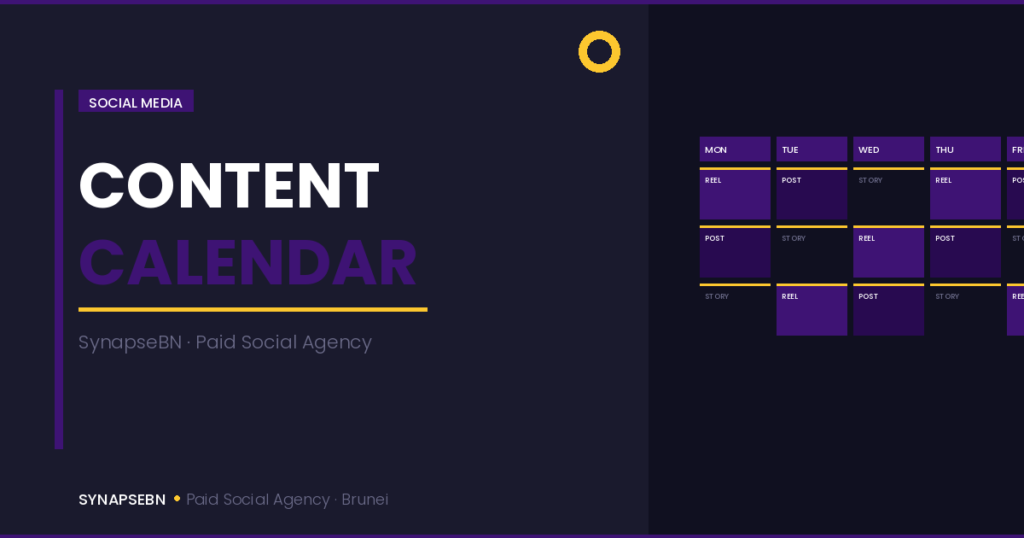
A functional format rotation for a four-to-five-post week on Instagram might look like this:
- One Reel (reach and discovery: new audiences who do not follow you yet)
- Two carousel posts (depth and engagement: people who already follow you)
- One or two static posts or Stories (consistency and community: low-lift content that keeps the account active between bigger pieces)
The Reel is doing the top-of-funnel work. It introduces you to people who have not heard of you. The carousels build the relationship with people who already know you. The value of Reels for organic reach is connected to the same principle we cover in our post on why Meta ad creative is the targeting: the quality and format of what you put out shapes who the algorithm shows it to. A strong Reel hook in the first two seconds determines whether it gets distributed or buried.
Stories sit outside this calculation. They are ephemeral, they only reach existing followers, and they are best used for the unpolished, real-time moments that make your account feel human rather than manufactured.
Planning Without Burning Out
The number one reason content calendars get abandoned is that the process of maintaining them takes too long relative to the results it produces. Planning sessions drag, content takes longer to produce than expected, and eventually someone asks whether all of this is worth it.
The answer to that is almost always structural. Hootsuite’s calendar workflow guidance consistently points to two practices that separate teams that sustain their calendars from teams that give up: batching and buffering.
Batching means producing content in concentrated sessions rather than one post at a time. One dedicated morning per week to shoot, write, and schedule everything going out in the following seven days is faster and produces better output than writing captions daily. It also preserves mental energy, because the context-switching cost of jumping in and out of content creation mode across the week is higher than most people account for.
Buffering means keeping two to three weeks of pre-produced content ahead of the posting schedule at all times. When something unexpected comes up: a team member is sick, a project runs over, or simply nothing inspiring is happening, you have cover. The accounts that go dark for two weeks because “we’ve been busy” are the ones with no buffer. The ones that stay consistent through chaos almost always have one.
A monthly planning session of sixty to ninety minutes, followed by one weekly batching session, is a realistic structure for most small businesses. The monthly session sets the theme, the mix, and the reactive slots. The weekly session produces the actual content. It is not glamorous, but it works.
The Bottom Line
A good social media content calendar is not a list of post ideas with dates attached. It is a system: a content mix that reflects what your audience needs at different stages, a cadence that your team can sustain without burning out, a format rotation that serves both reach and engagement, and enough buffer that one bad week does not derail the whole month.
Most of the businesses that tell us their organic social “just does not work” are not producing bad content. They are producing inconsistent content without a coherent mix, and the algorithm is reflecting that inconsistency back at them in reach and engagement numbers that go nowhere.
Before building your next calendar, ask yourself:
- Do you know what percentage of your posts are educational, community-focused, and promotional? Or do you just post whatever feels relevant?
- Can your team realistically sustain the posting cadence you have planned for more than eight weeks?
- Is there at least one Reel or short-form video per week in your plan to drive new audience discovery?
- Do you have two to three weeks of content produced and ready to go before the first post in your calendar goes live?
- When did you last audit which formats are performing and adjust the mix accordingly?
Getting this right does not require a large team or a complicated tool. It requires a clear framework, a realistic cadence, and the discipline to plan before you produce. That combination is rarer than it sounds, and it is almost always what separates the accounts that grow from the ones that plateau.
If you want help thinking through what a content calendar and organic strategy should look like for your business specifically, that is exactly the kind of conversation we have every week.
Book a free consultation with the SynapseBN team — no pitch, no pressure. Just a straight conversation about what’s working, what isn’t, and what to do about it.